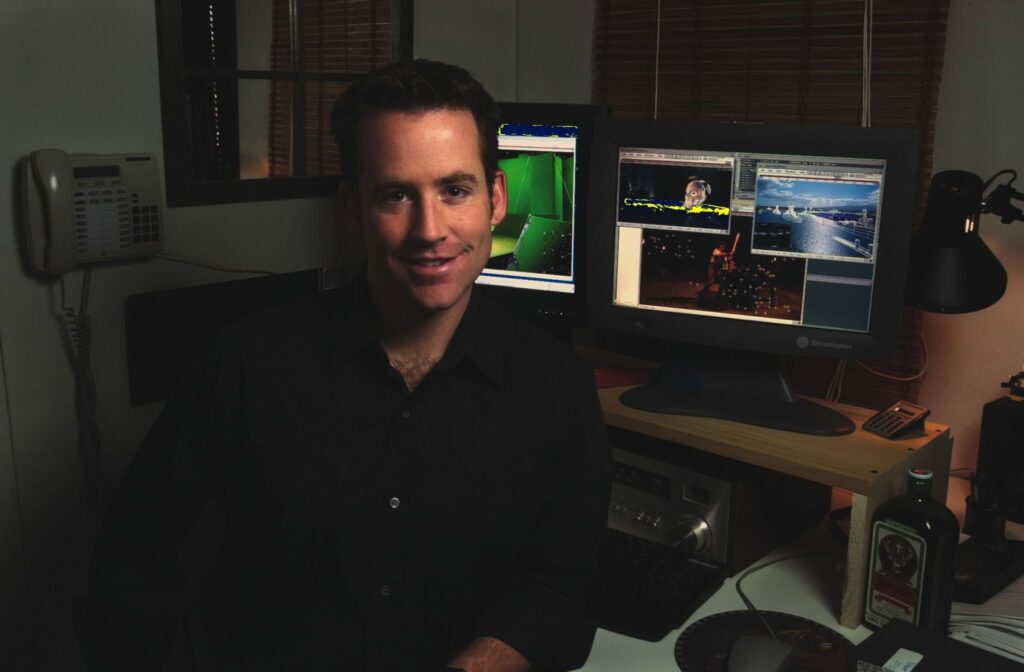
The technology used to create Davy Jones from “Pirates of the Caribbean: Dead Man’s Chest” and characters from other films was developed with the assistance of Steve Sullivan, a 1989 electrical engineering graduate. In addition to “Pirates of the Caribbean” films, Sullivan contributed to the making of the “Star Wars” prequels and the “Iron Man” movies. He also worked on “Avatar.”
For his work, Sullivan won three Academy Awards for technical achievement for the MARS matchmoving system, an image-based modeling system and the Imocap on-set motion capture system, in 2002, 2006 and 2010, respectively.
Share This Story
Spark a Memory?
Share your story! Fill out the form below to share your fondest memory or anecdote of S&T. If you'd prefer not typing, you can also share by phone at 833-646-3715 (833-Miner150).
Not your average Joe
You know all about Joe Miner, the world’s greatest mascot. But do you know Joe Minor, the civil engineer? Joseph…
Katie (Fritts) and Mitchell Niehoff
Katie (Fritts) and Mitchell Niehoff met in fall 2006 during that semester’s first meeting of the Perfect 10 Improv group….
Football, a history
The first game in Miner football history was played on Nov. 20, 1893, and the first Miner touchdown wasn’t scored…
Savannah (Signaigo) and Nathan Leezer
Savannah (Signaigo) and Nathan Leezer met during Greek Week activities in September 2010 when Nathan, a first-year Interfraternity Council representative,…
Rebuilding a flooded town
At its happening, the Flood of ‘93 was one of the worst crises to have ever impacted the St. Louis…
Earthquake stops baseball, starts inspections
Kamila Crane, who earned a bachelor’s degree (1985) and master’s degree (1986) in civil engineering, was prepared to start rebuilding…