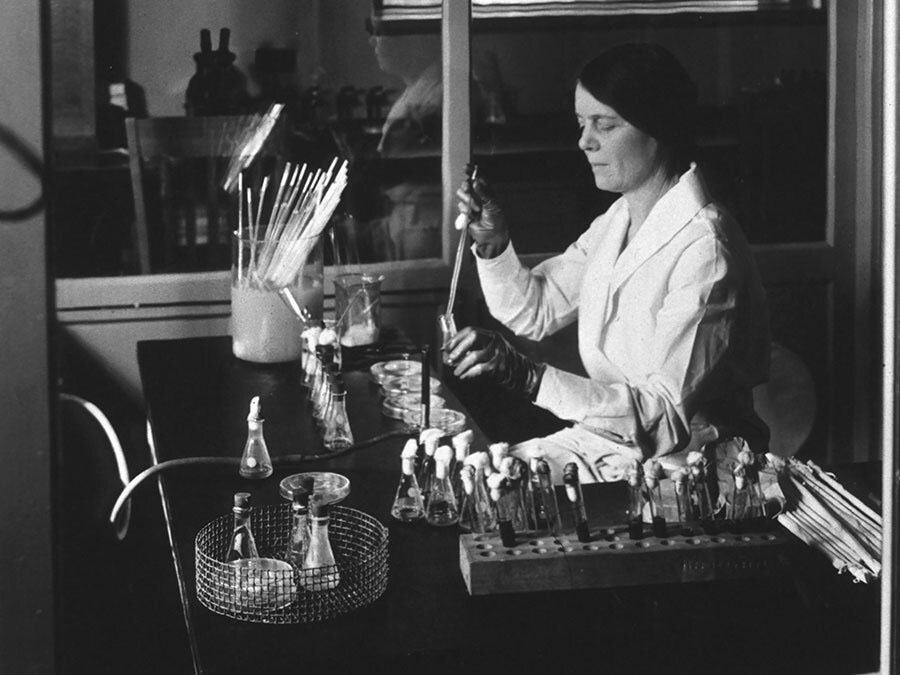
Dr. Ida Bengtson was the first woman the National Institutes of Health (NIH) hired as a scientist in 1916. For 30 years she served the NIH – and several communities throughout the U.S., including Rolla, as Dr. Kathleen Sheppard, associate professor of history at Missouri S&T, details in Selective Blindness: Ida Bengtson and the Treatment of Trachoma, published in Lady Science in 2018.
As Sheppard notes, Bengtson came to Rolla in 1924 to lead research on a blindness-causing eye disease named trachoma at the city’s hospital on 13th Street. She also worked as a lecturer in bacteriology at S&T and conducted research in lab space in Parker Hall’s basement.
Over 1,500 patients treated at the Rolla hospital benefitted from Bengtson’s research, and she shared the results of her work at a meeting of the Saint Louis Ophthalmic Society. Her work led to the creation of Rolla’s Trachoma Hospital, one of only four such hospitals in the country. (This building on Kingshighway is now home to S&T’s Rock Mechanics and Explosives Research Center.)
Bengtson worked in Rolla from 1924 to 1931 before moving on to work in the typhus unit of the NIH. She helped develop a vaccine for typhus and created the complement fixation test, a test still used today to detect Rocky Mountain spotted fever and other diseases.
“Bengtson is just one of those women whose successes became the disciplinary scaffolding that others would build upon,” Sheppard writes. “She contributed to multiple urgent projects because of her drive, her expertise, and her precision. Bengtson and her contemporaries laid the cornerstones of multiple fields and research lines, but few look for those cornerstones, which make finding sources about them almost impossible. Bengtson’s work on trachoma demonstrates the value of not just looking for ‘Female Firsts’ in science, but of understanding the breadth and depth of women’s contributions to multiple fields.”
Share This Story
Spark a Memory?
Share your story! Fill out the form below to share your fondest memory or anecdote of S&T. If you'd prefer not typing, you can also share by phone at 833-646-3715 (833-Miner150).
First woman department chair
In 1990, Dr. Elizabeth Cummins was named chair of Missouri S&T’s English department. She joined S&T as an instructor in…
Jennifer (Hoffman) and Terrence Sison
Jennifer (Hoffman) and Terrence Sison attended the same high school but didn’t know each other until they met at S&T…
From S&T soccer to the state capitol
You might think that with the thousands of graduates Missouri S&T has produced over its 150-year history, at least a…
Supporting female faculty at S&T
When she established the Woman of the Year award at Missouri S&T, Cindy Tang, a 1985 economics graduate, wanted to…
Bringing back the wetlands
Donald Hey, a 1963 graduate in civil engineering, is passionate about proving the economic efficiency and sustainability of using restored…
Jillian (Estes) and Charlie Stankovic
Jillian (Estes) and Charlie Stankovic met in 2013 after overhearing stories about one another. During finals week, they played sand…